MycoMap
- Duration
- February–May 2024
- Role
- Visual & UI Designer
- Focus
- Mobile Game Design · Visual & UI Design
Overview
MycoMap is a citizen science mobile game that encourages Scottish teenagers to explore the Dava Way and contribute to environmental data collection through mushroom identification and playful challenges.
Challenge
The Dava Way Association needed greater public engagement and participation, within limited resources.
Goal
Create an engaging outdoor learning experience that invites young people to explore the trail.
Approach
Connect real mushroom observations with guided identification, playful challenges and social interaction.
Solution
A mobile game and physical trail board that turn mushroom discovery into an approachable citizen science activity.
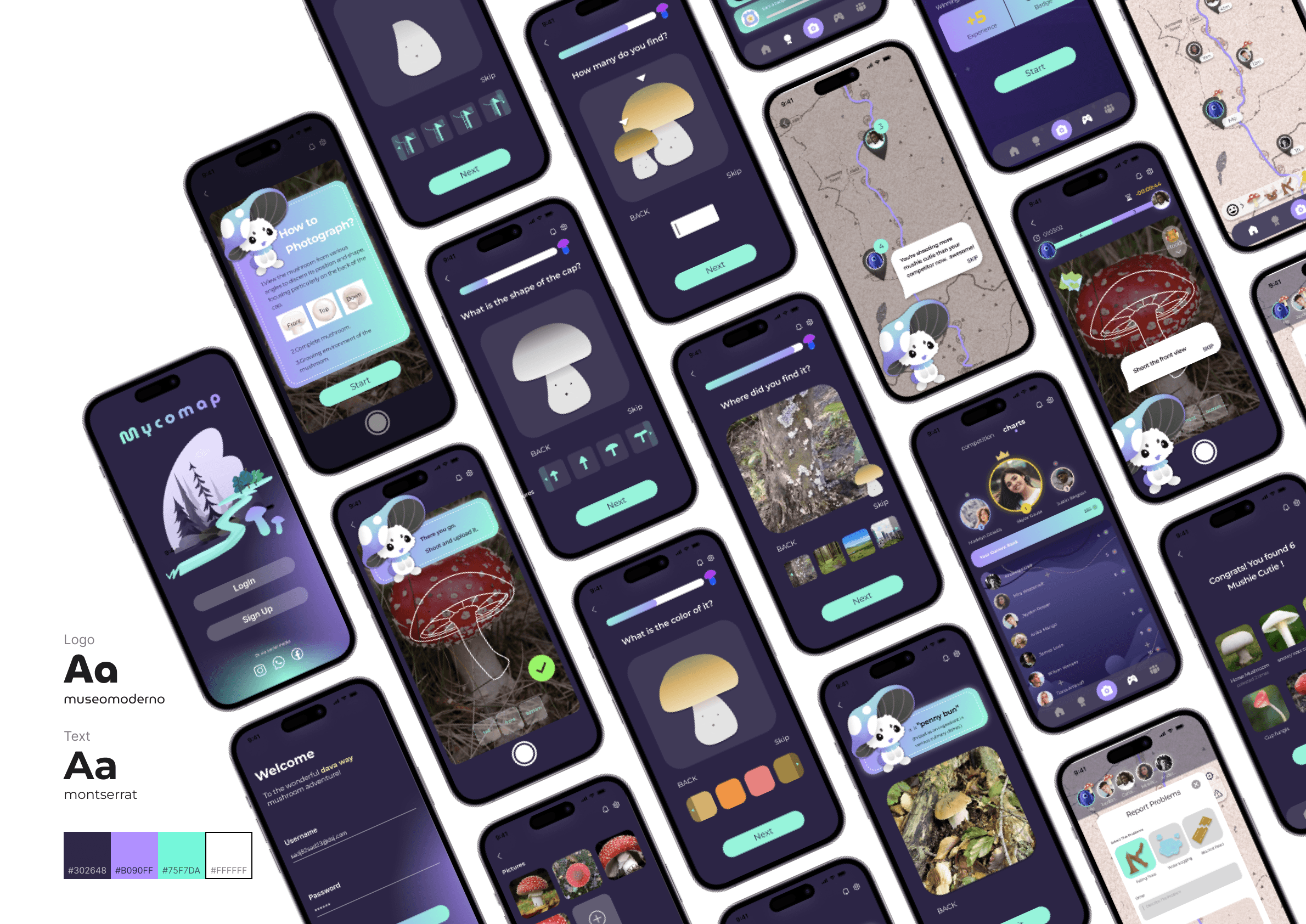
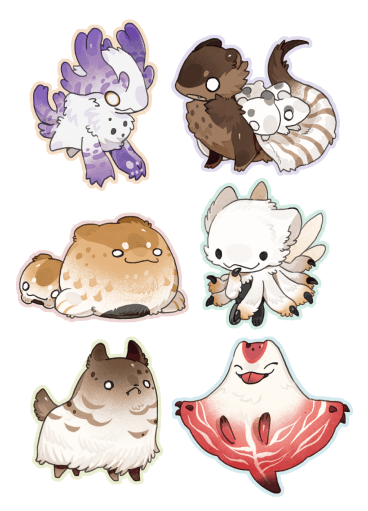
Visual style
The mushroom companion became rounder and easier to recognise. The purple fantasy palette came from students’ co-design preferences.
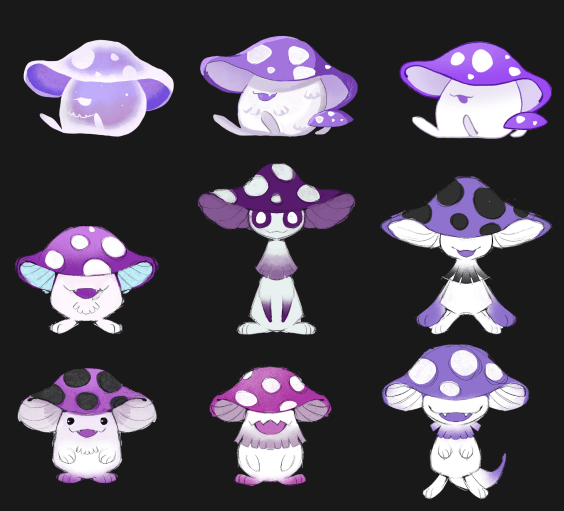
Background story
Players help the companion find and purify infected mushroom friends through identification. Competition and cooperation build purification power and unlock rewards.
Instructions
A short tutorial shows beginners how to photograph a mushroom from several angles.
Identification
Visual questions about shape, colour, size and habitat lead to a proposed identification and an observation record.
The identification concept was designed to support careful observation; scientific accuracy was not validated.
Reward & competition
Rankings, badges and quests show progress. A timed challenge invites players to find and record mushrooms together or compete for rewards.
Friends & communication
Players can invite friends and receive updates about their discoveries, rewards and progress.
Stickers instead of text
Visual stickers let players share finds and report trail problems to the Dava Way Association.
Interactive game board
The proposed waterproof wooden board offers a low-cost, physical invitation to play. A QR code reveals the matching answers and introduces the app.
Storyboard
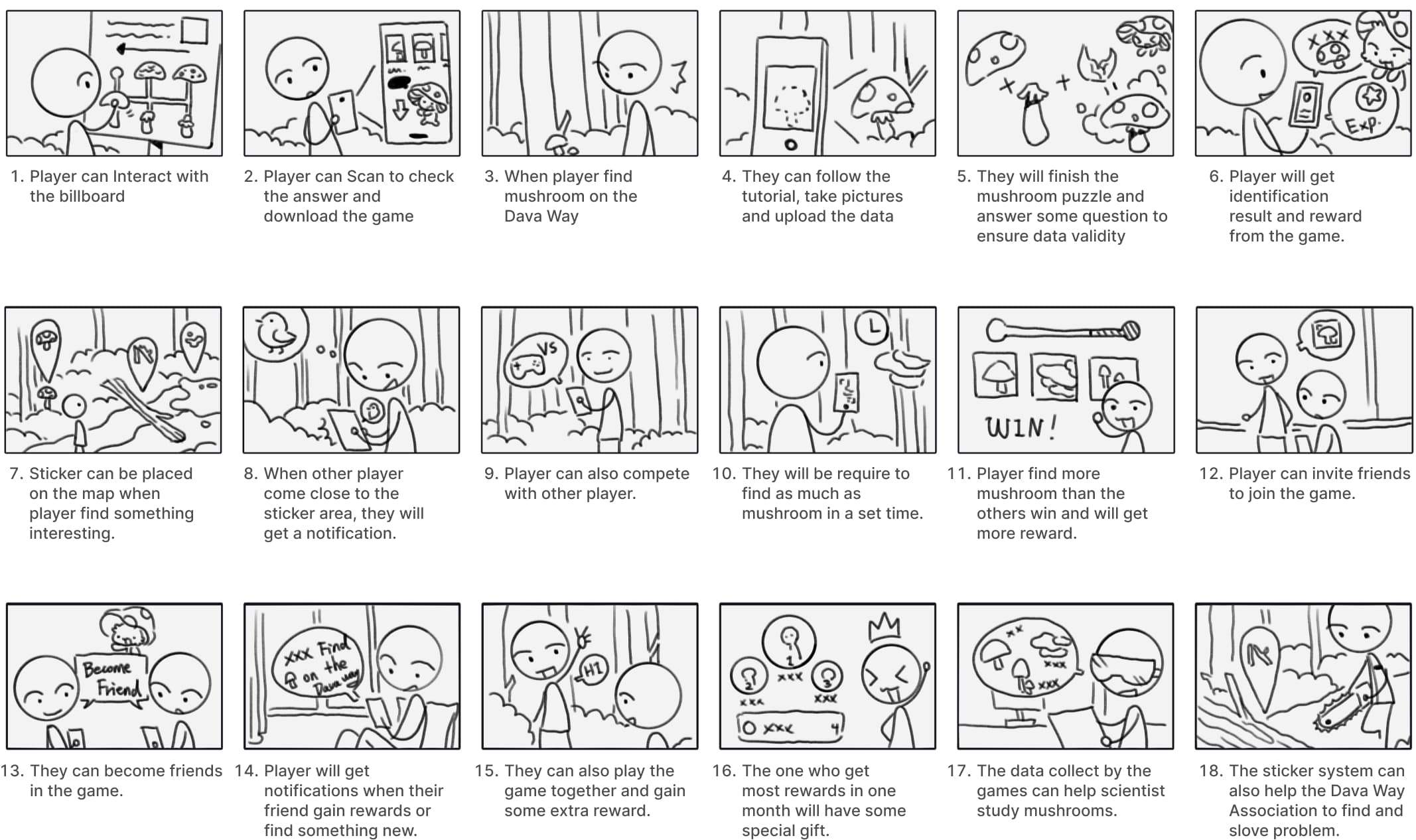
Concept Film
The video explains the app's features and usage scenarios in more details.
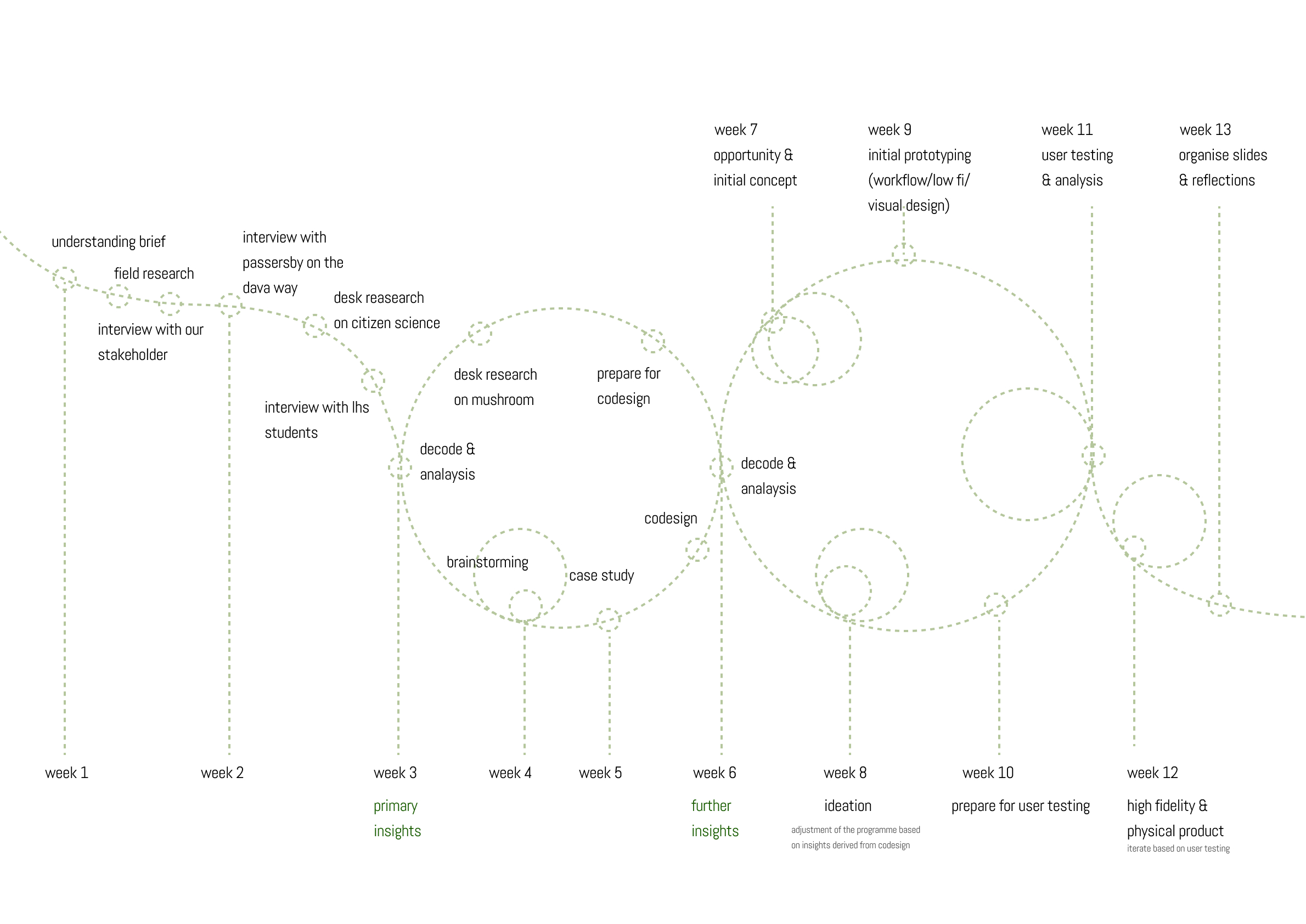
06 / Discover / Desk & field research
Start with the place and its people.
Understanding the Dava Way
The 24-mile route follows the former Highland Railway between Forres and Grantown-on-Spey, passing farmland, woodland and moorland. The Dava Way Association maintains it through volunteer effort, donations and grants.
Our brief connected three needs: more engagement with the trail, an educational experience for young people, and simple ways to collect environmental data.
Where citizen science fits
Citizen science involves members of the public in research. We considered both scientist-led data collection and projects shaped collaboratively with participants.
Contributory model
Scientists define the project → volunteers contribute data → researchers analyse observations.
Collaborative / co-created model
Participants and researchers shape the project together ↔ share knowledge, observations and decisions.
Fieldwork made the constraints tangible
On-site observations, an interview with Malcolm Campbell, and conversations with passers-by surfaced practical concerns alongside the trail’s natural appeal.
Resources are limited
Funding and volunteers constrain maintenance, publicity and new installations.
Access needs attention
Uneven surfaces, puddles, fallen trees and unclear entrances affect the walking experience.
Preserve what matters
Visitors valued the railway history and natural environment, alongside smoother and wider paths.
07 / Understand / Student session 01 · 13 February
Meet them through what they already love.
We asked about everyday routines, hobbies, outdoor activities and their understanding of nature, then analysed the interviews thematically.
Games sparked enthusiasm
Students noticed monster stickers and mentioned Pokémon. Competition, social play and fresh experiences offered useful starting points.
Nature felt less familiar
Interviews suggested limited knowledge of species and little regular outdoor participation beyond walking or cycling near home.
Friends influence participation
Peer influence and online media shaped game choices. A shared experience could create an invitation to explore.
Research persona / Kieran
Fresh experiences.
Friends. A good game.
The team’s 13-year-old persona represents a student in Lossiemouth who enjoys video games and social competition, walks or cycles near home, and has limited motivation for other outdoor activities.
A research synthesis, not an individual participant profile.
08 / Define / Finding the opportunity
Why mushrooms? Why a game?
| Subject | Potential | Constraint |
|---|---|---|
| People | Counts and activity records are accessible. | A weaker connection to the trail’s natural environment. |
| Animals | Diverse habitats offer interesting species. | Harder to find and photograph; seasonal availability varies. |
| Plants & fungi | Accessible observation, classification and seasonal records. | Many plants change slowly; mushrooms offer more variation in place and condition. |
| Water, air & soil | Environmental status can be recorded. | Less visible variation for the proposed discovery activity. |
Why mushrooms?
The team found them abundant, easier to photograph than animals, and variable across seasons and weather. Their unpredictable appearance suggested a treasure hunt.
Why a mobile game?
A phone could combine photographs, location, instructions and social play. The Association’s limited budget and technical skills favoured a shareable digital concept.
Why gamification?
Students’ enthusiasm for games suggested a way to make unfamiliar observation tasks inviting through visual puzzles, competition and rewards.
Match the science to beginner capabilities
Mushrooms matter as decomposers and plant partners, while gaps in fungal data make observation valuable. We focused on field records: time and location, size, photographs from several angles, growth stage and habitat. Laboratory analysis and microscopy sit beyond this beginner experience.
The research considered public platforms including FunDiS, Mushroom Observer and iNaturalist. These were references for possible data sharing, not implemented integrations.
Pokémon GO
The team valued its characters, rewards and outdoor discovery, while recognising the risk of screen immersion drawing attention away from the environment.
Spirits of Realms
Its recording process and backstory informed the concept. The team wanted stronger player interaction and more approachable classification for beginners.
09 / Explore / Ideation
Three different ways into nature.
The team explored several interaction models before using the next workshop to shape the direction.

01 / Emotional visualisation
A wearable device would translate contact with plants into expressions on an LED display while collecting environmental readings.

02 / A musical trail
Mushroom bioelectric signals would become music, building a personal soundtrack for the Dava Way journey.

03 / Competitive discovery
Players would photograph and upload mushroom observations within a set place and time, competing with one another.
These were early concepts. Competitive discovery offered a direction to explore through mushroom matching, genre choices and storytelling with students.
10 / Co-design / Student session 02 · 5 March
Let students shape the adventure.
We returned with mushroom matching activities, game genre choices and storytelling cards to understand both comprehension and motivation.
Start with matching
Students matched similar mushrooms and chose preferred game genres. Colour drew attention; complex illustrations were harder to distinguish.
Build a story together
Event, object and character cards helped students create stories around mushroom discovery on the Dava Way.
| Insight | Design decision |
|---|---|
| Pictures held attention more than text. | Visual identification puzzles and sticker communication. |
| Fantasy, heroic roles and supernatural stories appealed. | A mushroom companion and a story about rescuing infected friends. |
| Competition and player interaction were engaging. | Competitive discovery alongside cooperative and social play. |
| Rewards could motivate participation. | Badges, rankings, progression and special challenges. |
11 / Prototype / From insights to interaction
Give the adventure a clear structure.
We organised the experience around the citizen science sequence, then connected it to rewards, character progression and friends.
12 / Validate / Student session 03 · 23 April
Return to students. Refine what matters.
We tested low-fidelity interactions and hands-on activities at Lossiemouth High School to examine understanding, gameplay and visual preferences.
01 / Match & identify
Matching mushroom silhouettes to photographs tested the observation skills used in identification.
02 / Find & compete
A timed search for hidden mushrooms explored competitive discovery.
03 / Share & collaborate
Passing mushroom locations between players simulated sharing discoveries in the app.
04 / Navigate & choose
Students tried the low-fidelity prototype and chose preferred character and visual styles.
Favourite parts
Competition, the mushroom monster and social features.
Suggestions
More colour and a clearer return button.
What changed
We used this feedback to refine the visual style and navigation.
See the final UI ↑13 / Reflection
What comes next
Students’ feedback shaped the visual identity, identification puzzles and social features. The Dava Way’s remote location remains a barrier for younger visitors, so encouraging visits would require support beyond the game.
Future versions could explore more species, places, age groups and seasonal activities. Long-term participation and data quality still need to be tested.
- Ardoin, N.M., Castrechini, S., Hofstedt, M.K., 2013. Youth–community–university partnerships and sense of place: two case studies of youth participatory action research. Child. Geogr. 12 (4), 479–496.
- Bassiouni, D.H. and Hackley, C. (2016), "Video games and young children’s evolving sense of identity: a qualitative study", Young Consumers, 17(2), pp. 127-142. https://doi.org/10.1108/YC-08-2015-00551.
- British Trust for Ornithology. (n.d.). Registered Charity Number 216652 (England & Wales), SC039193 (Scotland). BirdTrack. [Online] Available from: https://www.bto.org/our-science/projects/birdtrack [Accessed 6 March 2024].
- Chin, C., Osborne, J., 2010. Supporting argumentation through students' questions: case studies in science classrooms. J. Learn. Sci. 19 (2), 230–284.
- Dahlberg, A., Genney, D. R. & Heilmann-Clausen, J. (2010). Developing a comprehensive strategy for fungal conservation in Europe: current status and future needs. Fungal Ecology, 3(2), pp.50-64. Available online.
- Gray, P. (2012) ‘The many benefits, for kids, of playing video games’, Psychology Today, 7.
- Harris, M.J. (2018) Color theory and its applications in marketing as it relates to color psychology. Ball State University.
- Hawksworth, D.L. (2012). Global species numbers of fungi: are tropical studies and molecular approaches contributing to a more robust estimate? Biodiversity and Conservation, 21(9), pp.2425-2433. Available online.
- Heilmann-Clausen, J., Bruun, H.H., Ejrnæs, R., Frøslev, T.G., Læssøe, T. and Petersen, J.H. (2019). How citizen science boosted primary knowledge on fungal biodiversity in Denmark. Biological Conservation, [online] 237, pp.366–372. doi:https://doi.org/10.1016/j.biocon.2019.07.008. [Accessed 6 March 2024].
- Holden, L. (2003) The fungi name trail: a key to commoner fungi.
- Junbo. (2023, May 26). How do you take a picture of a mushroom? [Online] Available from: http://www.mycopedia.top/blog.php?id=32 [Accessed 6 March 2024].
- Kim, K. et al. (2024) ‘Exploring the relevance of a psychology-based resilience app (JoyPopTM) for Indigenous youth’, Child Abuse & Neglect, 148, p. 106343.
- Motuihe Trust. (2019). Fungi Citizen Science Project. [Online] Available from: https://www.motuihe.org.nz/about-the-island/biodiversity/fungi-citizen-science-project/ [Accessed 6 March 2024].
- Mushroom Musume by MortallyMoonstruckGames, Autumnotopia, Minamiz, BearLovingNerd, Zaozoruzhna (no date). https://mortallymoonstruckgames.itch.io/mushroom-musume.
- National Geographic Society. (© 1996 - 2024). National Geographic Society is a 501(c)(3) organization. Bioblitz [Online] Available from: https://education.nationalgeographic.org/resource/bioblitz-citizen-science/ [Accessed 6 March 2024].
- Nintendo (2018). Poké Ball™ Plus. Available at: https://media.nintendo.com/pokeballplus/ [Accessed: 20/02/2024].
- Nintendo of America (2018). Pokémon: Let’s Go! - Play with Pokémon GO & Poké Ball Plus - Nintendo Switch. https://www.youtube.com/watch?v=1GrsVmwwPAg.
- Pocock, M.J.O., Chapman, D.S., Sheppard and Roy, H.E. (2014). Sepa choosingandusingcitizenscience interactive 4web final amended blue1. [online] Available at: https://www.ceh.ac.uk/sites/default/files/sepa_choosingandusingcitizenscience_interactive_4web_final_amended-blue1.pdf.
- Royal Society for the Protection of Birds (RSPB). (n.d.). Big Garden Birdwatch. Available from: https://www.rspb.org.uk/ [Accessed 6 March 2024].
- Scotland's Nature Agency. (2020). Scotland is internationally important for the brightly coloured fungi, including the hazel gloves fungus and tooth fungi. [Online] Available from: https://www.nature.scot/plants-animals-and-fungi/fungi#:~:text=Scotland%20is%20internationally%20important%20for%20the%20brightly%20coloured,including%20the%20hazel%20gloves%20fungus%20and%20tooth%20fungi [Accessed 6 March 2024].
- Sheehan, B. (2017). Mushroom Citizen Science in USA: From Species Lists to Mycofloras 2.0. [online] Available at: https://fundis.org/images/PDF/SHEEHAN_Citizen-Science_Fungi-Mag_Spring-2017.pdf [Accessed 20 Feb. 2024].
- Sheehan, B., Stevenson, R. and Schwartz, J. (2021). Crowdsourcing Fungal Biodiversity: Approaches and standards used by an all-volunteer community science project. Biodiversity Information Science and Standards, 5(e74225). doi:https://doi.org/10.3897/biss.5.74225.
- Trautmann, N.M., Shirk, J.L., Fee, J., Krasny, M.E., 2012. Who poses the question? Using citizen science to help K-12 teachers meet the mandate for inquiry. In: Dickinson, J., Bonney, R. (Eds.), Citizen Science: Public Participation in Environmental Research. Comstock Publishing Associates, Ithaca, NY, pp. 179–190.
- Walker, R., Schratz, B, & Egg, P. (2008). Seeing beyond violence: Visual research applied to policy and practice. In P. Thomson (Ed.), Doing visual research with children and young people (pp. 164-174). New York: Routledge.
- Wang, X.-W., Liu, S.-L., & Zhou, L.-W. (2021). Citizen Science Initiative in Taxonomy of Macrofungi in China 1.0. Mycosystema, 40(4), pp.844-850. doi:10.13346/j.mycosystema.200283.